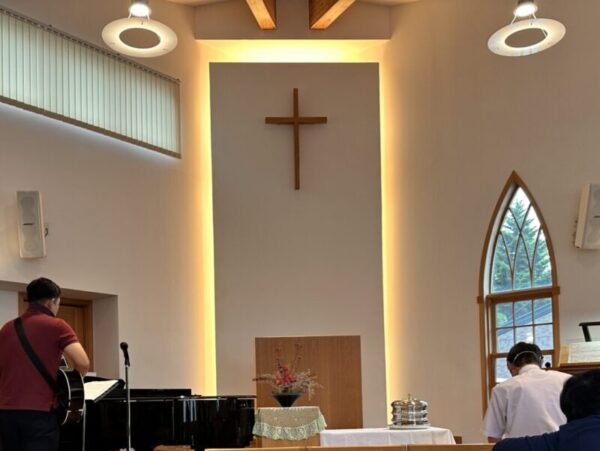
I’ll be honest—I don’t know how to pray in Japanese. Even after three years of studying the language and nearly completing the N3 course, my Japanese is still pretty basic. Prayer requires special vocabulary, and without focused learning, it’s hard to do it in Japanese.
My first visit to a Japanese church was at the Bible Church in Ishinomaki. Looking back, I’m truly grateful. Just a day before our visit, Ishinomaki was hit by torrential rain—the kind that makes travel impossible. We weren’t visiting the church that day, just sightseeing, and even then, the rain was overwhelming. I never imagined it could be that bad. But on the day we went to Ishinomaki, the skies were clear and sunny—not a drop of rain. What a blessing!
At the church, through the missionary’s translation, we heard the stories of three Japanese women and their journeys to faith. One of them became a Christian in high school, secretly attending church while pretending to study with friends—something that reminded me of friends back home who hid their faith from family because their families didn’t approve. Another woman became interested in Christianity after reading a novel by Ayako Miura and eventually sought out a church. I never thought a novel could lead someone to Christ! It made me realize there are countless ways to share the gospel if we’re willing to be creative and intentional.
The missionary invited us to pray together. She prayed fluently in Japanese, and although I understood only fragments, I knew how much effort it must have taken to reach that level. People might assume she loved Japanese culture and was already proficient before becoming a missionary—but the truth was the opposite. She once disliked Japanese culture and originally planned to serve in mainland China. Yet God called her to Japan. Hearing her speak fluent Japanese now was astonishing.
What struck me most was how close the missionary seemed to the three women. They spoke with her like old friends, openly sharing their feelings. From what I know, Japanese people are usually reserved—polite and friendly on the surface, but not quick to open up. Later, other missionaries told us that sharing the gospel in Japan requires building genuine relationships. You need to show sincerity, and people can feel it. Honestly, that’s true everywhere—even in Hong Kong.
After the prayer, we had a deep conversation with one of the women using AI tools like Google Translate. She told us about her two sons—one working in Tokyo and the other living with her in Ishinomaki. Her younger son, in his thirties, already has diabetes. When we asked if she had shared the gospel with him, she said no—she just keeps praying for him. Sharing faith with family is hard, whether in Japan or Hong Kong.
Later, we prayed together again, and this time the woman prayed in Japanese. They called God “kami-sama.” The word “kami” is familiar from Japanese dramas and anime—it means “god.” But in those shows, it’s not the Christian God. Hearing them say “kami-sama” this time felt special—realizing that the God they worship is the same God we believe in.
Christianity teaches that our God is the one true God. But what does it look like when people from different countries believe in the same God? For the first time, I felt that wonder—Japanese people believe in Jesus too. And they have truly experienced His guidance and grace. This was my first time feeling that so deeply.
Maybe because of this experience, I feel an even stronger desire to share the gospel with others. I believe God is working in countless ways around the world to draw people to Him.
After visiting the Bible Church, we went to the Ishinomaki earthquake memorial. Standing there, I felt the overwhelming power of natural disasters and the fragility of human life. The museum displayed reflections from survivors—questions about the meaning of death and the hope for life. These are exactly the questions our faith seeks to answer. At that moment, I prayed for them, asking God to bring His gospel to those searching for hope.
We also met a pastor during the visit. He had eye problems that prevented him from driving—a hobby he loved—and made it hard for him to study the Bible in its original languages, something he cherished. It must be painful for him. Before leaving, we prayed together. Since he had studied in the U.S. and spoke fluent English, I prayed for him in English.
Japanese believers, like us, trust in the same God. They pray, and they pray together. Prayer not only shows support for others but also expresses faith in God—believing He will show mercy and grace, that He will use His mighty hand and wisdom to save us and give us peace, joy, hope, and blessings.
Language may be a challenge, but prayer is a practice that brings blessings—to us and to those we pray for.